Since the release of ChatGPT in late 2022, AI has dominated discussions around the future of the workplace. Promises of efficiency, productivity and wealth generation have been weighed against the risk of job losses and the loss of life purpose in the face of mass automation.
In recent months, discussion of the knock-on effects for employment–for junior positions in particular–has begun to intensify. Using data from the 2025 All In Census, a voluntary survey of over 14,000 advertising employees, we analyse advertising employees’ feelings around AI: its usefulness; their enthusiasm to use it more; and the perceived likelihood of it taking their job
Overall numbers
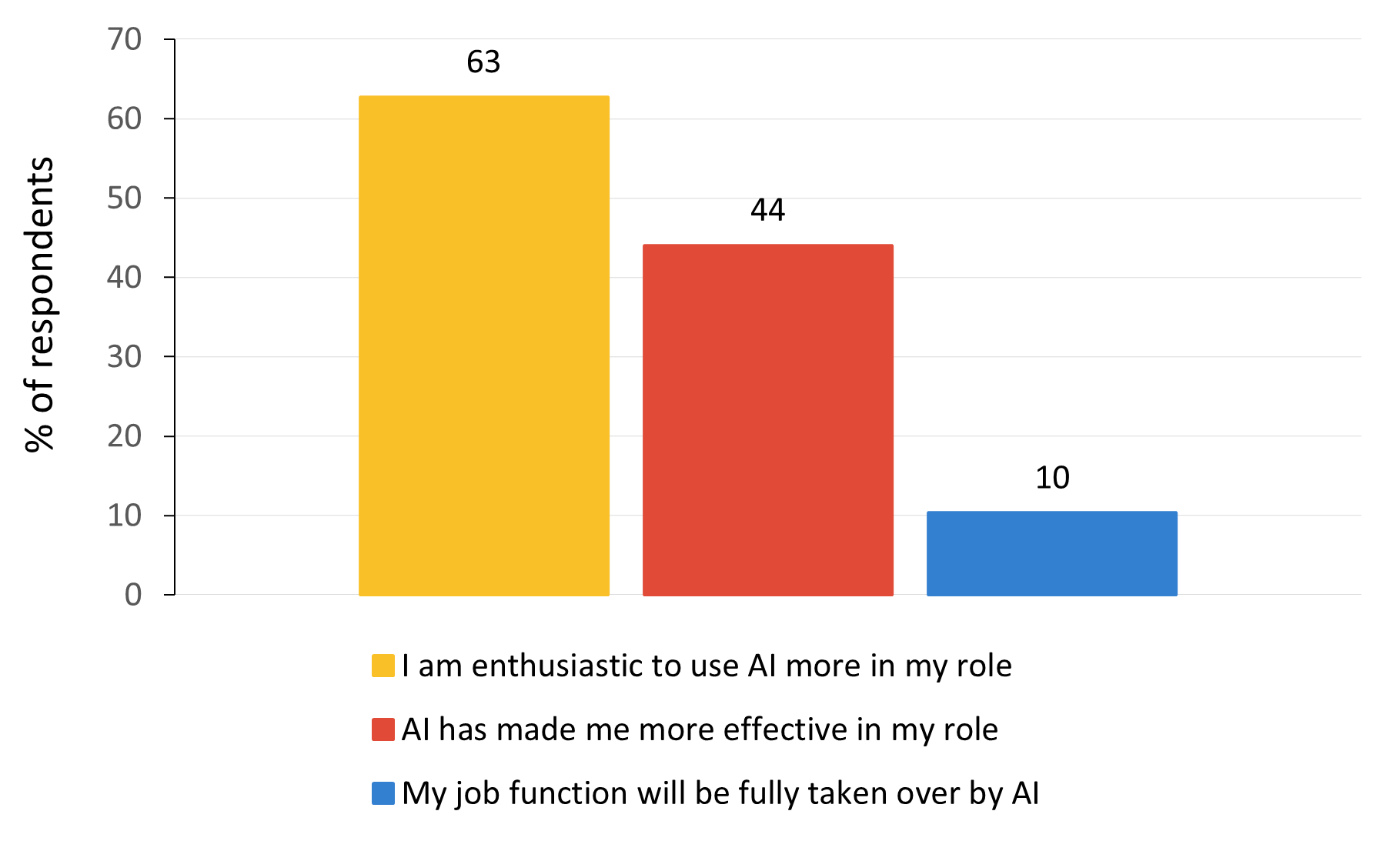
Looking at the overall numbers for the industry, there seems to be a general positivity around AI. As Figure 1 shows, 63% of advertising professionals are enthusiastic about using AI more in their role, while 44% feel it has made them more effective already. On the other hand, 10% feel that their job function will be fully taken over by AI; perhaps fewer than might be imagined when reading recent reports.
Figure 1. Agreement with statements on AI’s impact
Showing: Strongly agree + somewhat agree
n = 14,241
There are of course some factors that influence a person’s views towards AI use in the workplace, including their job function and seniority, which we explore here.
Junior jobs
Recently, reports have begun to show that the fears around job losses may be coming to fruition, especially when it comes to junior positions, with Dario Amodei, CEO of Anthropic, warning that “AI could wipe out half of all entry-level white-collar jobs” in the US[1].
It has also been reported that, since launching their in-house “AI colleague” in 2023, McKinsey have cut 5,000 jobs while incorporating 12,000 AI agents[2]. McKinsey themselves state that “young graduates are potentially facing a triple-whammy: a general labour market slowdown, a sharper decline in graduate-level job openings, and reduced demand for lower-skilled roles”[3].
Adverts promoting AI workers, including Artisan’s campaign urging companies to “stop hiring humans”, have attracted further comment. Though the company themselves say they “don’t actually want people to stop hiring humans” but instead help “make every job more human”[4].
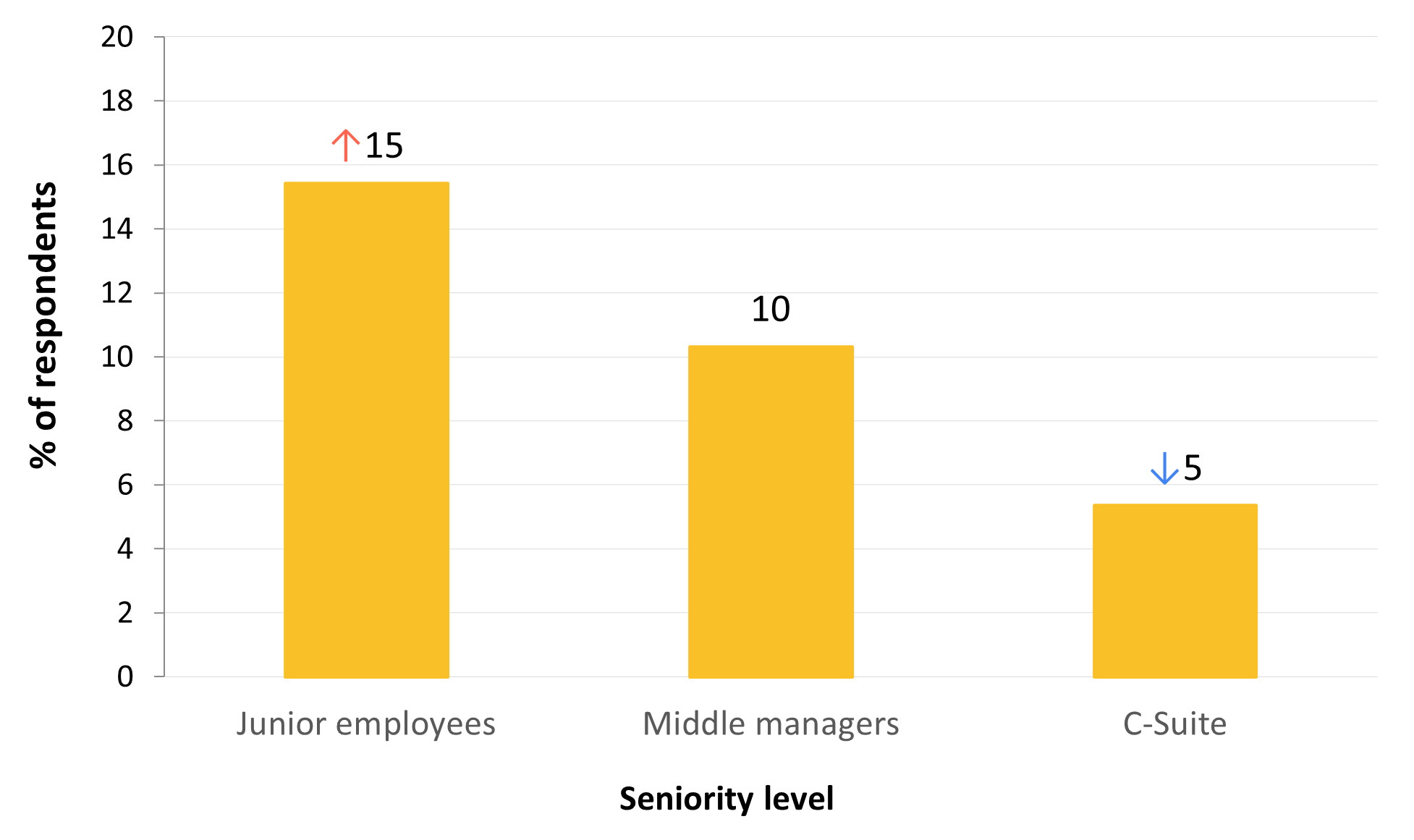
What do junior people in the advertising industry think about AI, then? First, fears of job functions being taken over by AI appear to decrease with seniority, as Figure 2 shows.
Figure 2. % of Advertising Professionals Who Believe Their Job Will Be Fully Taken Over by AI, by seniority level
Showing: Strongly agree + somewhat agree
n = 14,241
This data appears to support fears that junior positions are more vulnerable to AI displacement, with leadership roles the most shielded from AI obsolescence. The most junior roles, especially those that perform repetitive and mundane tasks, may be at greater risk of cuts and AI displacement.
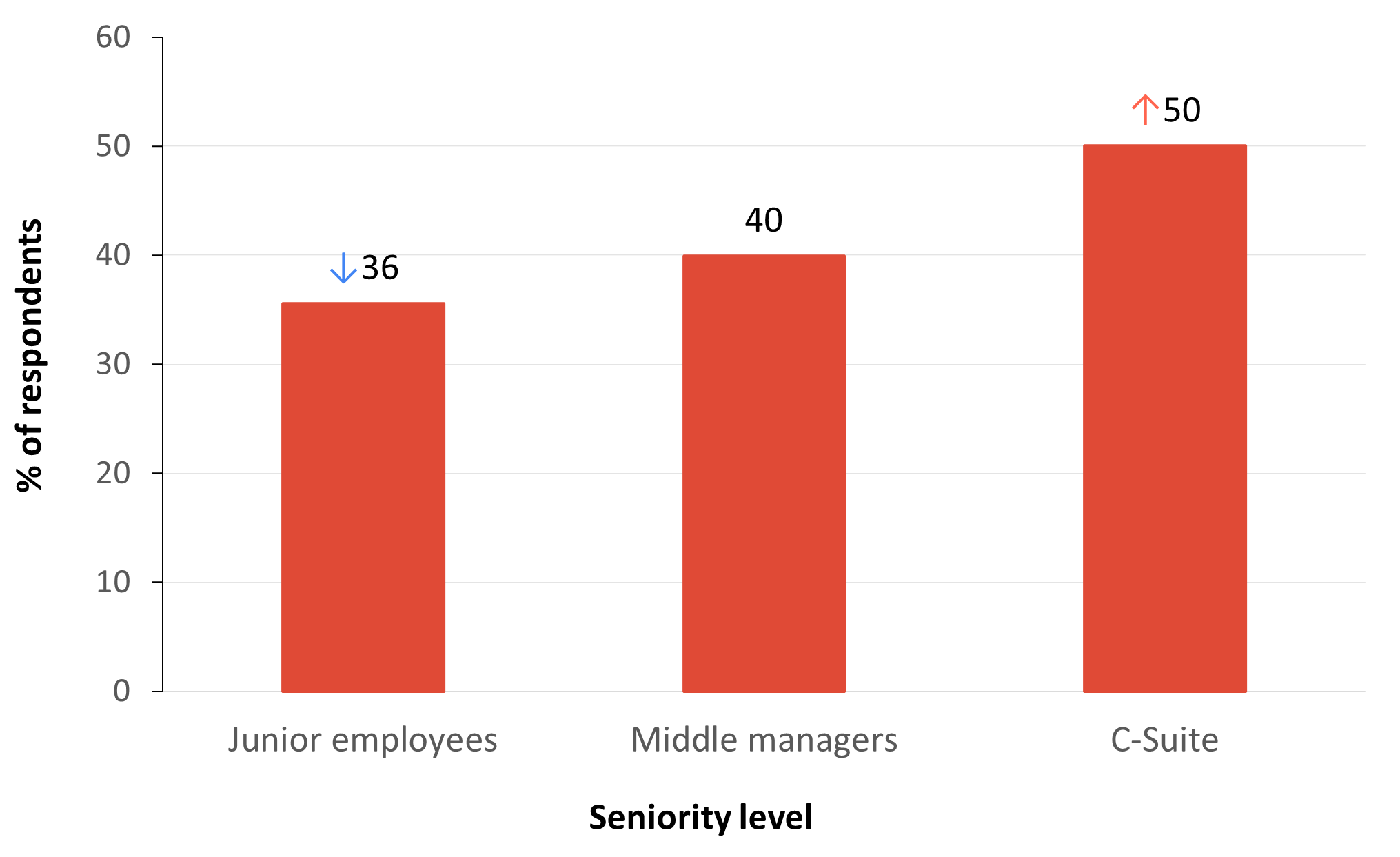
Interestingly, though, junior employees are the least likely to say that they use generative AI regularly to complete tasks, as shown in Figure 3.
Figure 3. % of Advertising Employees Who Use Generative AI Regularly to Complete Tasks, by Seniority Level
Showing: Strongly agree + somewhat agree
n = 14,241
This may just be due to the nature of work that some junior employees are performing. Roles such as runners and team assistants are likely less relevant for AI adoption to perform tasks because they involve physical activity. Of course, junior roles encompass a huge range of areas within the advertising industry, with some junior positions being more at risk of automation than others.
However, it is important that the industry gets a handle on this issue as the technology develops, to avoid significant gaps in recruitment and continue to offer young people a way into the industry.
Why this matters
If junior employees are right that their job functions are more likely to be fully taken over by AI, then entry routes into the industry will become harder to find. This is because, traditionally, tasks which are repetitive, mundane and admin-heavy have been completed by junior employees as an entry point to the industry. As these more easily-automated jobs are performed by AI, opportunities to train, develop and progress will be restricted to an even more limited field of applicants.
For graduates looking for roles in advertising, if entry routes are being closed off due to AI, other industries, perhaps blue-collar ones which tend to be less impacted by AI use[5], may necessarily become more appealing.
Which job functions are the most worried about job losses?
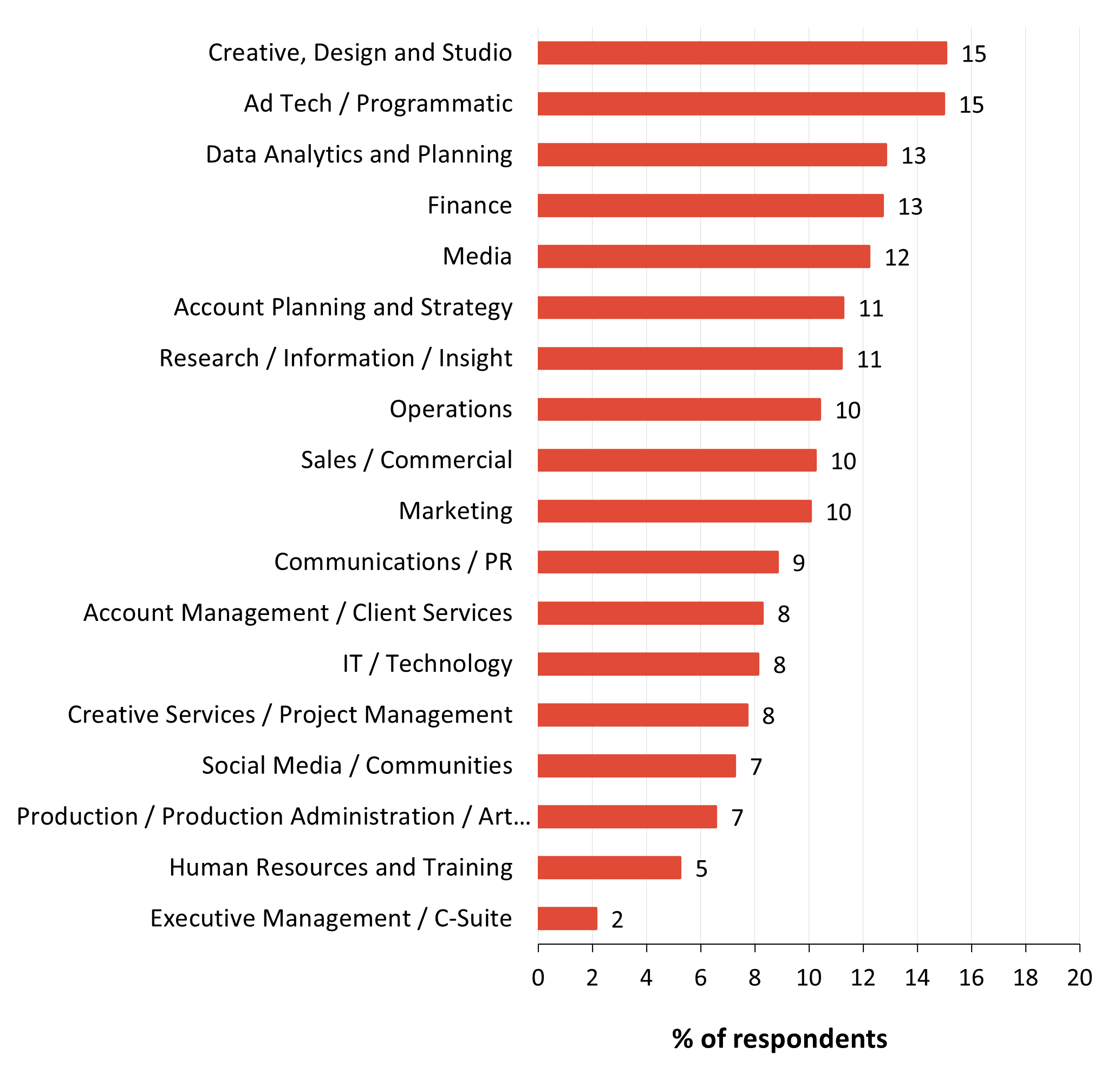
Aside from junior positions being the most vulnerable, some job functions are often seen as particularly at risk of AI displacement. The most worried, according to the All In survey dataset, are those in “Creative, Design and Studio” roles and those in “Ad tech/programmatic roles”, as shown in Figure 4.
Figure 4. % of advertising professionals who believe that their job function will be full taken over by AI, by job function
Showing: Strongly agree + somewhat agree
n = 14,241
In a similar vein to the trend seen with senior leaders feeling less exposed to AI obsolescence, the job function least concerned about AI taking their job is Executive management/C-Suite. Only 2% of those in these roles agreed that their job function would be fully taken over by AI.
It is understandable that HR and Training roles were the next least concerned; sensitive HR disputes and training being handled by software still feels a long way off for most companies.
Of course, while some jobs are being displaced by AI as tasks are automated and streamlined, new jobs will inevitably be created to support, manage and operate new technologies. The research so far seems to suggest that AI is augmenting rather than fully replacing roles and tasks, though[6].
Why this matters
The two most concerned functions, ‘creative, design and studio’ and ‘ad tech/programmatic’ demonstrate the huge range of professions which fear AI obsolescence. ‘Creative, design and studio’ roles may be reacting to generative AI in particular reducing the need for the historic level of human creative input, while ad tech/programmatic roles require less traditional creativity. Whether these jobs are really at long-term risk of being fully taken over by AI, or whether they will just evolve as individual tasks are automated away, the fear exists.
Not only does the industry need to grapple with the futures of some of the most at-risk job functions, but providing support and guidance for those afraid of losing their careers to AI will be necessary.
AI adoption and productivity gains
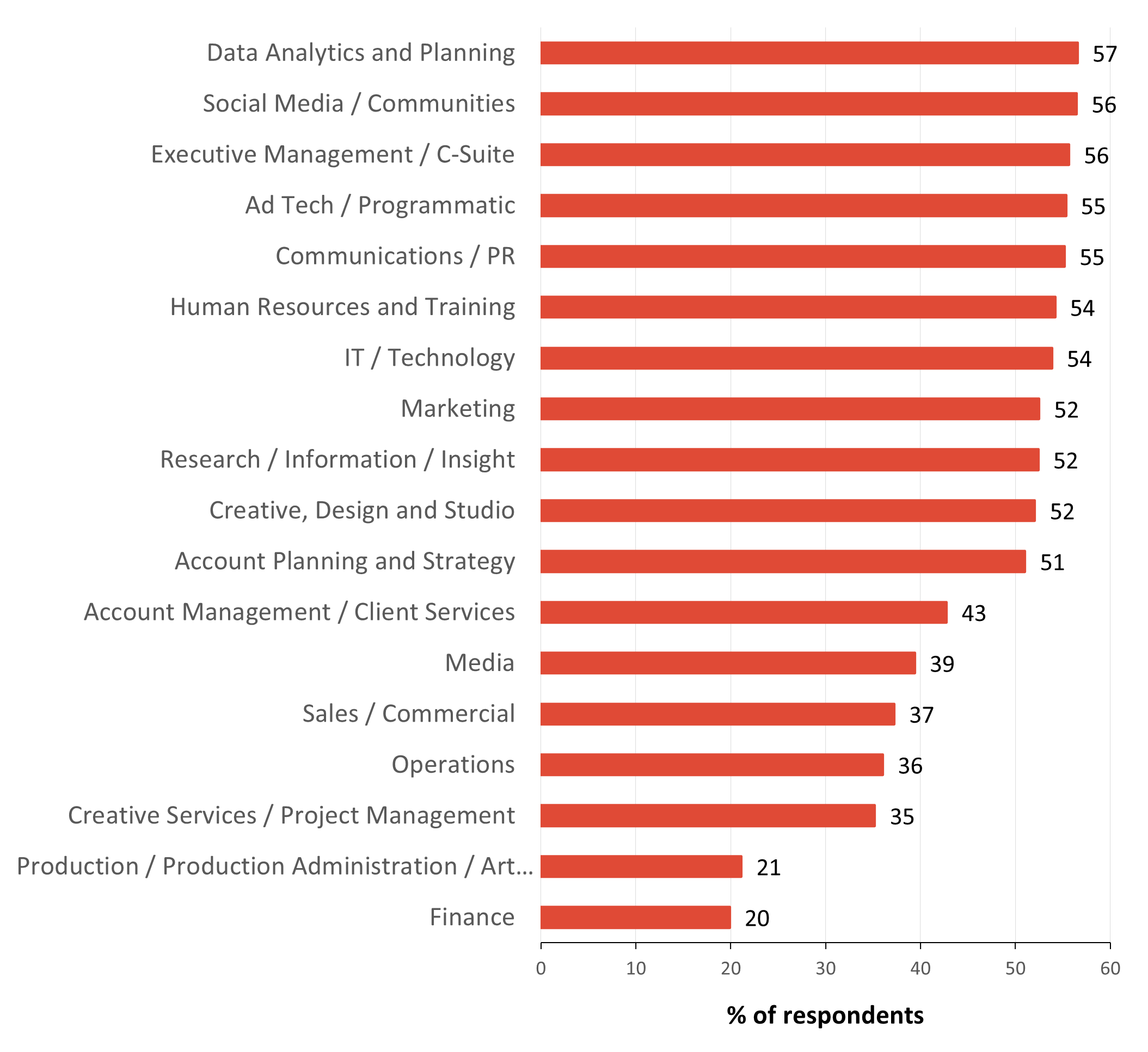
Interestingly, despite HR employees and executive management being the least worried about AI displacement, they are also more likely to believe that AI has made them more effective in their role, as shown in Figure 5.
Figure 5. % of advertising professionals who believe that AI has made them more effective in their role, by job function
Showing: Strongly agree + somewhat agree
n = 14,241
This suggests that employees in these two job functions are in the most positive position concerning AI, seeing efficiency gains while remaining less concerned about displacement.
Those in Ad Tech/programmatic focused roles are being the most heavily affected by AI, being the joint most likely to feel that AI will fully take over the job function, while also already heavily using the technology to improve role efficacy.
What is also clear from Figure 5 is how broadly the impact of AI is being felt across the advertising ecosystem, and how much it is already being applied successfully. In most role, over half of employees feel that advertising has made them more effective at their role.
Finance employees, however, are so far the least impacted and enthusiastic about AI. As Figure 5 shows, they are the least likely to feel that it has made them more effective, while also being the least likely to feel enthusiastic about using AI more in their role. Just 44% feel this way, compared to the industry average of 63%.
It may be that finance teams feel that human the level of automation already introduced into the process is nearing optimal, with further automation and AI input putting accuracy and checking at greater risk. Those in production roles, too, are less positive about AI’s impact on their job effectiveness. This is likely again a function of highly inter-personal, hands-on work that is not easily improved by AI.
Conclusion
The advertising industry stands on the cusp of an AI-driven era and many professionals see AI as an enabler, with clear productivity gains already emerging. Yet the technology’s uneven impact, particularly on junior roles and certain job functions, signals a need for deliberate managerial action.
If the industry is to harness AI’s potential without hollowing out its talent pipeline, leaders must firstly invest in reskilling. Resources such as the Advertising & Marketing Training Hub, with hundreds of free or affordable courses are a good place to start, but internally training in larger companies can work even better.
Next, creating meaningful entry points for young talent is more important than ever. As the industry continues to look at the effectiveness of the apprenticeship levy, updating the types of roles that are on offer to graduates will be crucial to avoid junior people completing tasks that AI can automate easily.
Finally, keeping human creativity at the heart of advertising’s work will help preserve jobs that provide value. Just because AI can do a job, doesn’t mean it should.
The outlook from the industry is broadly positive, however. There seems to be widespread adoption of AI which has improved the quality of work, with a reasonable reaction to job obsolescence that does not reflect the level of concern displayed in the wider media.
References
[1] https://www.axios.com/2025/05/28/ai-jobs-white-collar-unemployment-anthropic
[2] https://thefinancestory.com/mckinsey-deploys-12000-ai-agents#:~:text=Since%202023%20(yes%2C%20same%20year,replacing%20humans%2C%20it’s%20redefining%20roles.
[3] https://www.mckinsey.com/uk/our-insights/the-mckinsey-uk-blog/ai-uneven-effects-on-uk-jobs-and-talent
[4] https://www.artisan.co/blog/stop-hiring-humans
[5] Working with AI: Measuring the Occupational Implications of Generative AI
[6] Working with AI: Measuring the Occupational Implications of Generative AI