By Stephen Woodford, Chief Executive, Advertising Association
We have long known the advertising sector is a critical engine of the economy. One measure of this is the amount invested each year in commercial media. For many decades, the Advertising Association has partnered with WARC to publish the definitive measure of total UK advertising expenditure.
The UK advertising market’s trajectory has been exceptional. Current projections indicate the UK advertising market will effectively double in nominal value, from the £24 billion recorded during the 2020 pandemic to an estimated £49.8 billion in 2026.
Recently, we implemented the most significant methodological update to this reporting framework in its history, guided by our new AA/WARC Forum. This forum convened stakeholders across the media ecosystem, including IAB UK, IPA, ISBA, Newsworks, Marketreach, Outsmart, the Cinema Advertising Association, PPA, Radiocentre and Thinkbox.
Through this collaboration, we have implemented three structural changes to improve the reporting, the deduplication of media totals, the introduction of standalone reporting for social and retail media, and a revised, definitive classification for Addressable TV.
Historically, overlapping metrics perhaps obscured the nuances of digital market expansion, masking the reality that digital infrastructure now underpins all traditional media channels. By disaggregating “online display” into its constituent parts, we have eradicated the double-counting that previously affected top-line reporting. Furthermore, in partnership with the IAB and its recently appointed data consultancy, Oliver Wyman, we can now model the entire market with unprecedented accuracy, deliberately backdating figures to 2024 to ensure robust, like-for-like analytical comparisons.
This methodological transparency helps to identify and explain the primary catalysts of market expansion. Social media now represents slightly over two-thirds of the total online display market, achieving £11.5 billion in 2025 following a substantial 21% year-on-year growth. Similarly, Retail Media has solidified its position as a strategic growth driver, growing by 17.5% to £3.7 billion. This sector’s rapid ascent can be explained by its targeted use of first-party data to reach consumers at the point of purchase, a strategic strength that maps well against shifting consumer behaviors toward shopping online.
Additionally, we have integrated a precise definition for Addressable TV, developed in consultation with Thinkbox. This framework defines Addressable TV as a buying mode enabling marketers to target specific audiences, households, or individuals with precision within high-quality, trusted television environments. Reflecting this update, Addressable TV generated £1.8 billion in 2025, representing a remarkable 37% increase.
Bringing all the investment together, we can see that the total UK advertising market expanded by 6.4% in 2025, reaching a total valuation of £46.7 billion. However, adjusting for high inflation, real-term market growth was 2.9%. Furthermore, as highlighted by the IPA, there exists a clear disconnect: while the advertising market has doubled over six years, the broader UK economy has experienced virtually zero growth. This divergence underscores the strategic need to continually analyse the underlying dynamics beneath our top-line figures.
These reports serve as a primary indicator of the UK’s economic health. Consequently, we are advocating for a definitive shift in the way we talk about these figures: we should move from describing and discussing ‘ad spend’ to ‘advertising investment’. While traditional accountancy standards struggle to classify advertising as an amortisable asset, due to the difficulties of attribution, analysts and investors rightfully prioritise it as a fundamental investment in demand creation, demand conversion, and sustained business growth. Our initiative, “The Success Files,” launched in partnership with the Times and Sunday Times, is specifically designed to demonstrate this vital economic contribution at the enterprise level.
While our revised framework offers unprecedented clarity, the AA/WARC Forum’s work will continue as we establish protocols for the next phase of market measurement. First, we want to quantify the scale of ‘long tail’ of advertisers and better understand the investments made by big brand and other large advertisers. We currently lack a definitive structural breakdown of investment across large corporations, medium enterprises, and small businesses. With an estimated 3.5 million businesses advertising in the UK – compared to approximately 6,000 on television – segmenting this volume is critical to understanding the many and varied drivers behind advertising’s expansion.
Second, we must formally classify the investment into Influencer and Creator marketing. This discipline has matured into a complex network of independent, multi-channel businesses representing a new way of commercial storytelling. It’s a strategic priority to distinguish this growing sector from traditional paid social media to accurately measure its economic footprint and trajectory.
Finally, we must prepare for the structural integration of Generative and Agentic AI. As artificial intelligence increasingly shapes the path to purchase and disrupts both creative production and media procurement, tracking how it works with established channels – such as search, which currently commands two-fifths of the market at £17.8 billion – will be critical to future reporting.
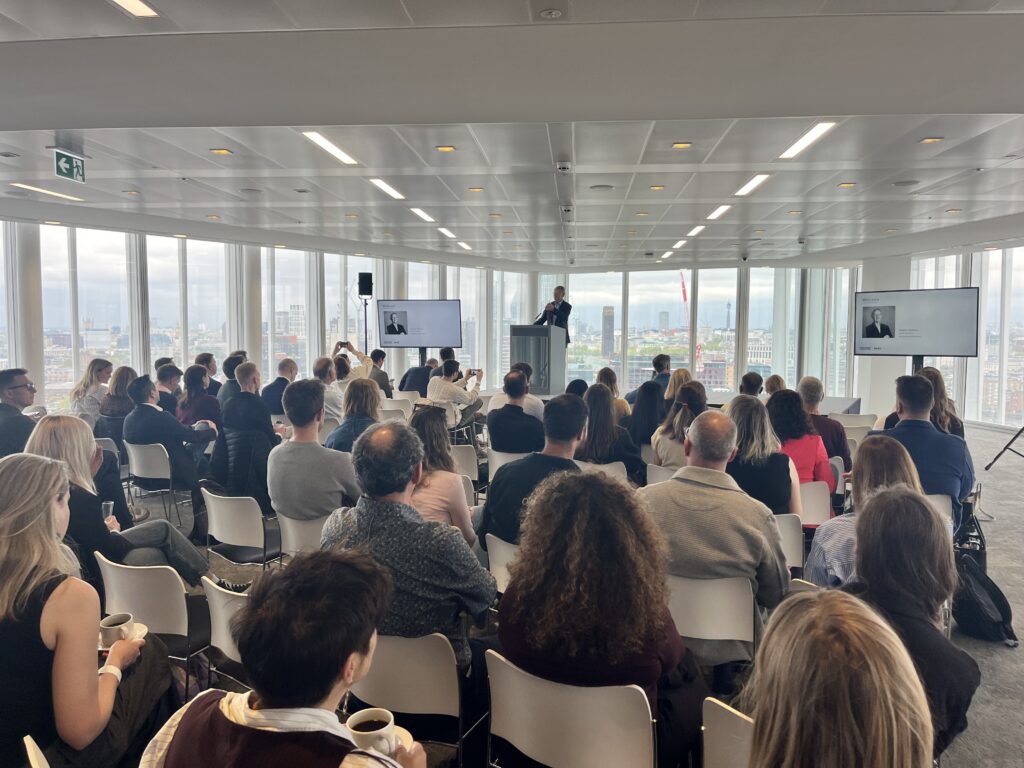
Finally, I want to thank James McDonald, who has meticulously directed the WARC reports over 50 quarters for more than a decade, who is moving on to an exciting new role overseas. He reflected at our recent presentation of the data at News UK that while it took two full decades for the online advertising market to double following the year 2000, our total market is currently projected to double between 2020 and 2026.
Reflecting this growth demands robust and trusted data, sustained industry-wide collaboration, and the confident recognition of advertising as a driver of UK investment and future prosperity.