Exclusive Interview for Trusted Advertising
In this excerpt, Gideon Spanier, Editor-in-Chief of Campaign UK, argues that trust in advertising is a “fragile commodity” that has been severely pressured by the rise of social media and fragmented ad inventory. He notes that the massive concentration of ad spend within a few global tech platforms has made it increasingly difficult for brands to control the context in which they appear. Spanier emphasizes that where brands choose to spend their money is critical, and advertisers must be vigilant about what content their budgets are funding rather than compromising on their environments. Warning against the modern “blurred world” and the “commercialisation of polarisation,” he concludes that while brands currently enjoy high levels of trust, failing to invest in trusted journalistic content ultimately threatens both their own brand safety and broader democratic consensus.
Gideon Spanier has been writing about the business of media and advertising for more than a decade. He joined Campaign magazine as Head of Media in 2015 with a remit to cover media owners, agencies and brands and started writing at a time when ad spend was shifting away from print and moving largely into the big tech businesses. He became Editor-In-Chief in 2020 and was Chair of the British Society of Magazine Editors (BSME) in 2024, providing him with an extensive perspective across the publishing ecosystem.
Spanier believes that trust has always been an issue for everyone working in media, but particularly so since the rise of social media. This is because the media provide information and suddenly people had a choice of many more sources of information, with social media helping to aggregate ‘relevant’ news for individuals. That this happened at the same time as the advent of advertising through search and social on the tech platforms was essentially a double whammy for the business models of publishers.
He described trust in advertising as ‘a fragile commodity’, something which has been under pressure for a long time. For brands, trust is inherently important, he says, foundational, but with the massive increase in advertising inventory available to advertisers and the accompanying fragmentation, it is much harder to control where brands show up. As such, Spanier suggested, perhaps brands have been prepared to compromise on the environment in which they appear, in terms of content and audience, a little too much.
During his time as a journalist, various media channels have had their own crises of trust, whether the UK tabloid press with the phone-hacking scandal or tech platforms with problems around ‘hate speech’ or content linked to terrorism. These moments have led to temporary suspensions of advertising, and he observes that when advertisers move as a pack and withdraw spend it can have a powerful effect. However, a single advertiser with just their own budget has limited impact, especially in the context of a global mega-platform, and most are reluctant to ‘take a stand’.
His view is that where you choose to advertise is more important than where you don’t and that advertisers have a responsibility to know where their money is going and what it is funding. We asked him if he believes advertisers do enough to support a trusted media environment and he replied he wasn’t sure that it’s really their job. The easiest way instead is for them to choose not to spend money where there might be content – toxic or hateful – that they would rather their brand isn’t associated with. It is the government’s job to regulate the media.
The structure of media choices has changed greatly during his time covering media. He has witnessed the globalisation of ad spend – the tenfold increase in spend with four or five tech platforms, while the spend with the media buying agency groups has stayed largely flat. A real concentration of power has resulted.
In this sense, the owners of today’s tech companies are much like the press barons who founded the Advertising Association a century ago, wielding huge influence across editorial and advertising content. He cites one significant difference between President Trump’s two election campaigns is the second’s closer alignment with the major tech platforms because of the influence they offer. Where US advertisers choose to advertise has become more politicised as a result, with impending US regulation also a factor.
Meanwhile media buying groups, even as they have globalised, have less control over total ad spend compared to ten years ago. They haven’t grown at the same rate as the tech companies and through financial representation of a collection of advertiser clients, their motive is economic, not ethical, he suggests. There is also a strong advertising ecosystem built around collaborations and partnerships, leading to a reluctance to rock the boat.
The nature of supply and demand has changed forever as the world’s advertising industry has moved from serving thousands of companies to millions in the ‘long tail’. Even big brands on the major platforms have a small share of spend compared to that they might have with other kinds of media owners. The world’s biggest brands, however, still carry weight because their advertising is held to a higher standard by the public. Spanier believes top advertisers (famous companies) must make much more careful decisions about where and when they appear, because of the general scrutiny they are under.
Spanier looks positively on the fact that younger generations understand brands more and appear to trust them more. They are more likely to call brands out, and ‘cancel culture’ is a threat, but in their chosen media where brands can provide entertaining content, “brand and editorial content feel like they have parity”. It’s clear to Spanier that entertaining and engaging content still drives the best results for advertisers, but he does believe that the fragmentation of media has led to a reduction in big, stand-out brand campaigns.
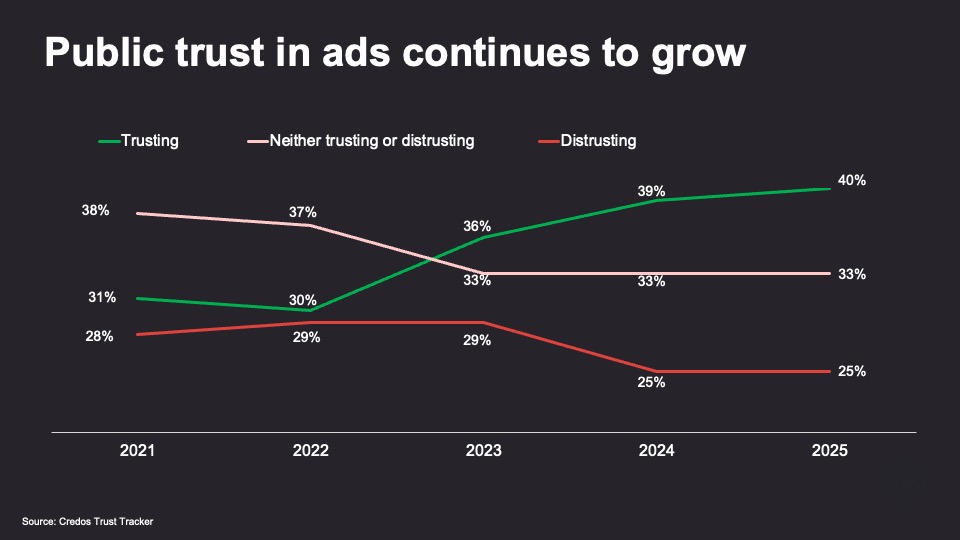
When it comes to trust, Spanier says we are now living in a different era which brings a genuine challenge to society. We live in a ‘blurred world’ where the dividing lines between fact and fiction, between advertising and editorial, are not as a clear as they once were. The ‘collapse of consensus’ can mean that more extreme positions can be popular and profitable, leading to what Spanier calls the ‘commercialisation of polarisation’ by some media owners. At the same time, as advertisers’ creative palettes are expanding with the exciting prospects brought by gen AI, that same technology brings massive challenges when it comes to trust.
But trust in brands is high, says Spanier, and research like Edelman’s shows they have the opportunity and the ability to lead. It’s now about how they show up. This is the opportunity for advertisers when it comes to trust, to build on this by appearing in the right places that appeal to them and their audiences.
He is clear that advertisers are under no obligation to support journalism but reminds us that journalists are there to find out the truth and keep hold of it in the face of those who may seek to undermine facts for their own commercial interests.
He urges advertisers to remember the importance of context when it comes to trust in their own brands. The consequence of a decline in trusted content through reduced ad spend is, in his view, a threat to democracy and, from an advertiser perspective, will result in a diminished choice of trusted environments for brands to enjoy.
This is an excerpt from the book Trusted Advertising written by Matt Bourn and James Best CBE.
Finished reading the article? Try the quiz below to test your knowledge.
1. Who does Gideon Spanier believe is primarily responsible for the regulation of the media?
A) Media buying agencies
Incorrect!
B) Individual brand managers
Incorrect!
C) The tech platforms themselves
Incorrect!
D) The government
That’s right! Spanier explicitly states that while advertisers choose where to spend, it is the government’s job to regulate the media.
2. Why does Spanier believe that the ‘world’s biggest brands’ must be more careful about their advertising placements than smaller companies?
A) They are legally required by the government to fund high-quality journalism
Incorrect!
B) Their advertising is held to a higher standard and subject to more general scrutiny by the public
Correct! Because famous companies are under scrutiny, they must make more careful decisions about where they appear.
C) They represent the majority of the total spend on global tech platforms
Incorrect!
D) They are the only advertisers capable of using generative AI in their campaigns
Incorrect!
3. According to Spanier, what is the ‘parity’ felt by younger generations in their chosen media?
A) The equal distribution of ad spend between tech platforms and traditional publishers
Incorrect!
B) The matching levels of trust they place in government and corporate brands
Incorrect!
C) The balanced representation of all political viewpoints within social media algorithms
Incorrect!
D) The feeling that brand content and editorial content are equally entertaining or engaging
Correct! For younger generations in their chosen media, ‘brand and editorial content feel like they have parity.’
4. Which factor does Spanier suggest drives the best results for advertisers, despite media fragmentation?
A) Focusing exclusively on 'cancel culture' trends
Incorrect!
B) Strict adherence to traditional print formats
Incorrect!
C) Entertaining and engaging content
Correct! Spanier explicitly mentions that entertaining and engaging content still drives the best results for advertisers.
D) Placing ads solely on search engines to avoid social media controversy
Incorrect!
5. What does Spanier identify as a long-term threat to advertisers if trusted content continues to decline?
A) An immediate ban on all generative AI tools in the advertising creative process
Incorrect!
B) The total elimination of the 'long tail' of small-scale advertisers
Incorrect!
C) A return to the dominance of print media over digital platforms
Incorrect!
D) A diminished choice of trusted environments in which brands can safely appear
Correct! A decline in trusted content results in a ‘diminished choice of trusted environments for brands to enjoy.’